

KIZUNA™: Building a Custom ERP
KIZUNA™ Ops evolved from several isolated internal tools (mostly one's own) into a custom ERP that centralizes AM25’s clients, projects, documents, payments, and operations within a single platform built around its actual workflow.
| Country | El Salvador |
| Design | Alejandro Mártir |
| Develop | Alejandro Mártir |
| Disciplines | Development, Web Design |
Scope
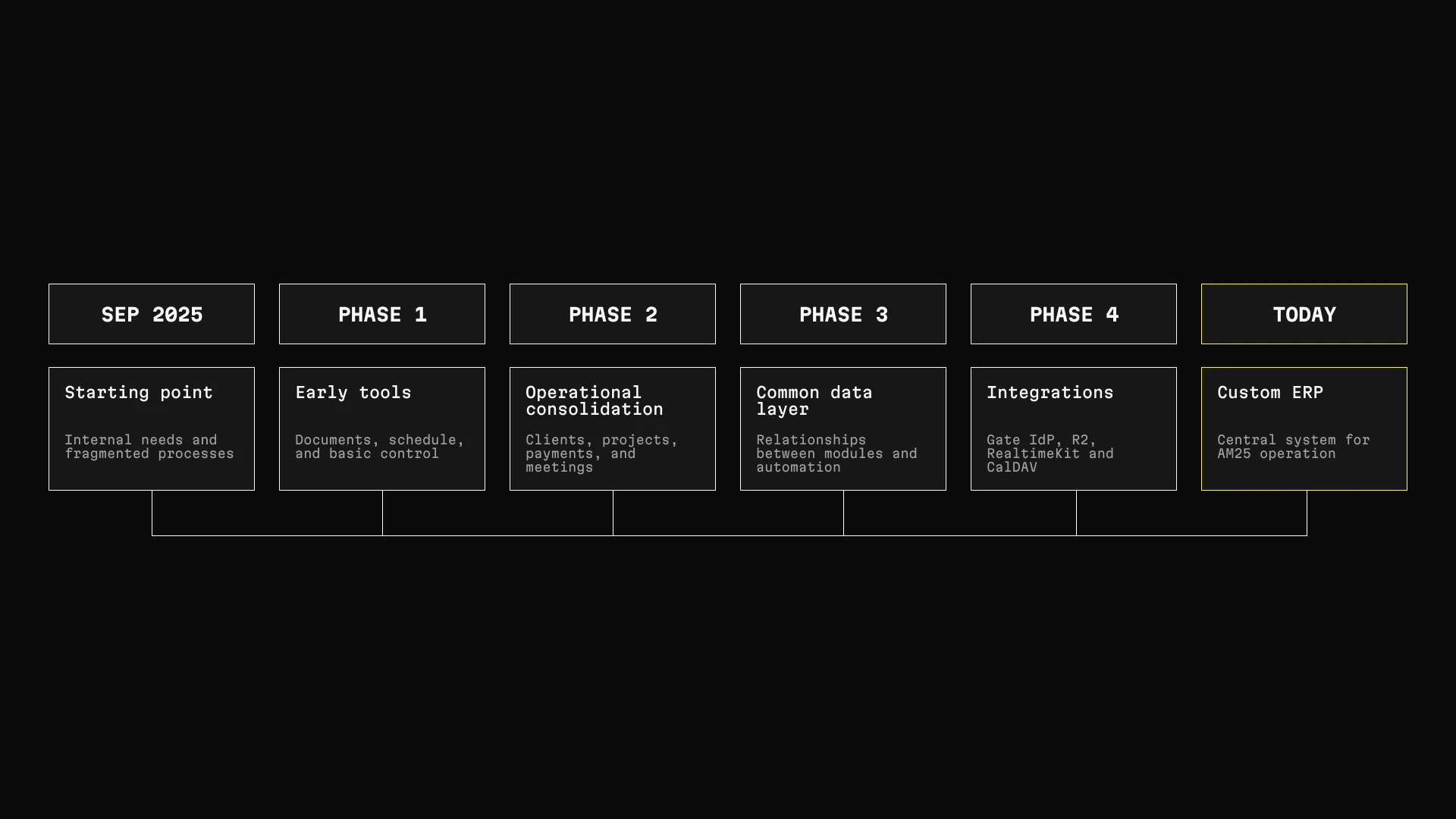
KIZUNA™ Ops began in September 2025 as an internal initiative to digitize AM25’s administrative operations from its earliest stages. What initially consisted of small standalone applications for managing corporate records, accounting entries, file transfers, and projects gradually evolved into a fully integrated operational platform built to measure.
During its first year, the scope expanded until KIZUNA™ Ops became a custom ERP with CRM capabilities, able to centralize clients, services, projects, documents, payments, calendars, meetings, files, timelines, automations, and other processes essential to the studio’s daily operations.
Problem
As a newly incorporated company operated by a single person, AM25 needed to structure its administrative, accounting, and operational processes without turning every new requirement into another subscription, another isolated application, or another spreadsheet that would later require manual upkeep. The first solutions emerged from very specific problems: keeping the General Journal and corporate records digitally, transferring large files through privately controlled infrastructure, and having a dedicated tool for organizing projects.
However, as these applications grew, maintaining them independently began to reproduce the same issue they were originally meant to avoid: fragmented information spread across disconnected systems. The challenge therefore shifted from digitizing individual tasks to designing an environment around AM25’s specific workflow rather than adapting the business to the limitations of generic commercial software.
Research
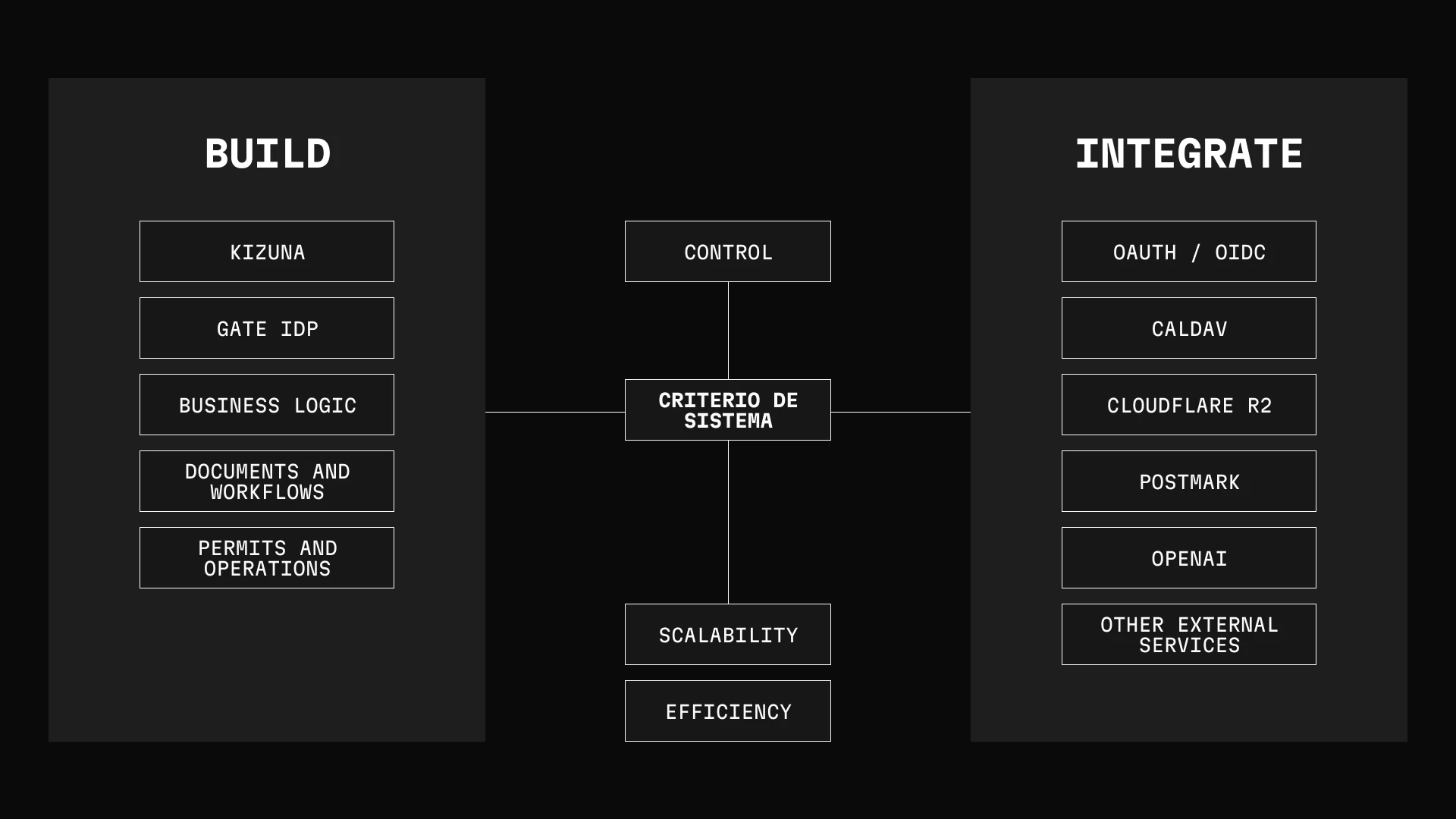
KIZUNA™ Ops development was guided primarily by continuous real-world use within AM25. Each module emerged in response to an existing operational need, making it possible to observe directly which information had to be centralized, which processes could be connected, and which could be automated. In parallel, the project required evaluating standards, APIs, and services that could support custom capabilities without rebuilding infrastructure already handled effectively by specialized solutions: OAuth 2.0 as the authentication foundation through Gate IdP, AM25’s internal identity provider; CalDAV for interoperability with calendar applications; Cloudflare R2 for object storage; RealtimeKit for real-time communications; and the OpenAI API for integrating artificial intelligence capabilities. The research was not about reproducing existing products feature by feature, but about identifying which parts of them were genuinely useful within AM25’s operational workflow and how they could be integrated under a common model.
Solution
The solution was to consolidate the original applications into a single modular platform built with Next.js, Prisma, and PostgreSQL, while keeping Gate IdP as an independent internal solution for authentication and access control. By sharing a common data layer and entity model, KIZUNA™ Ops could connect processes that had previously operated in isolation: client and service data feeds quotations, contracts, and receipts; projects connect to timelines, stages, and checkpoints that are also visible through the client portal.
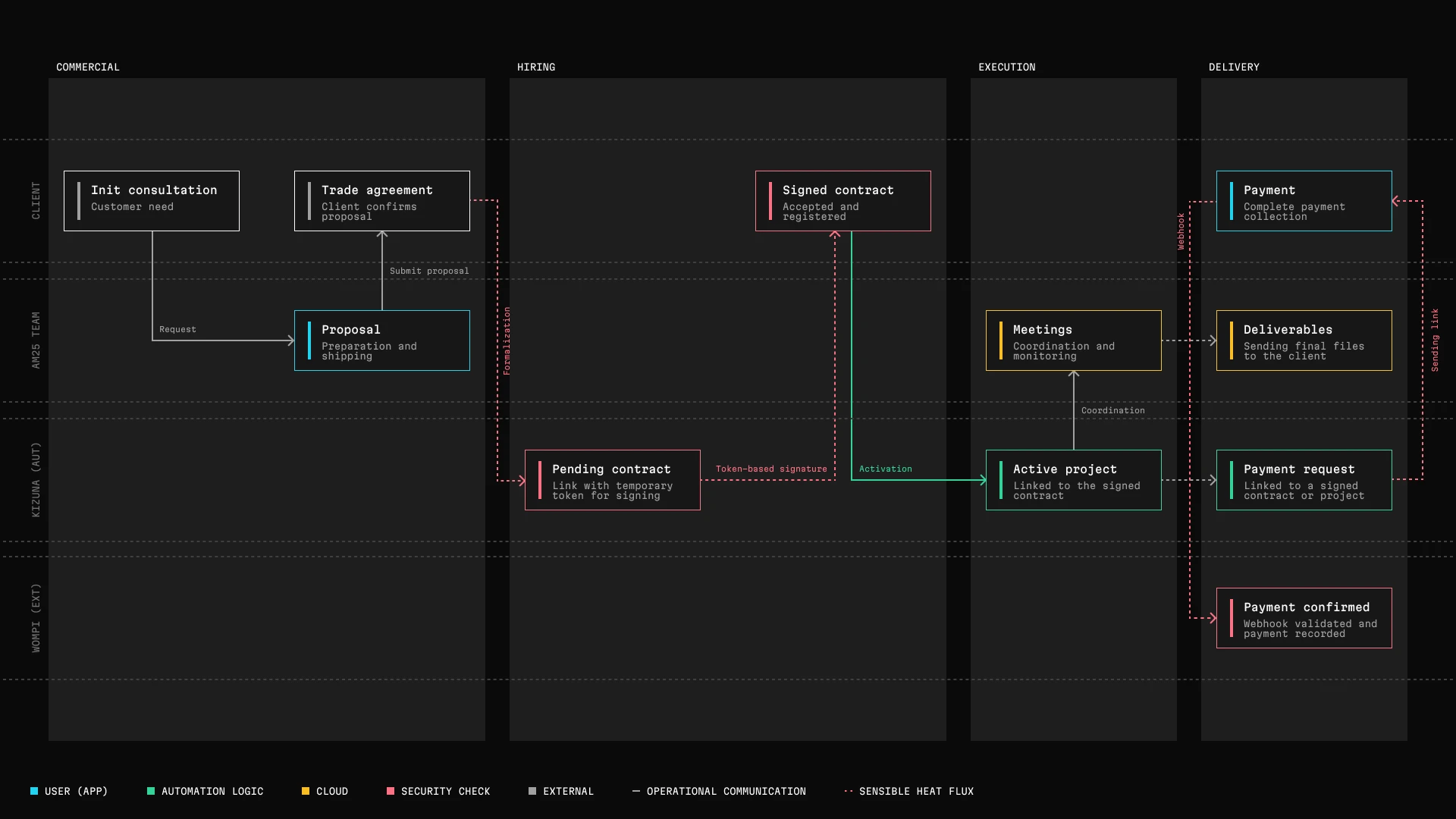
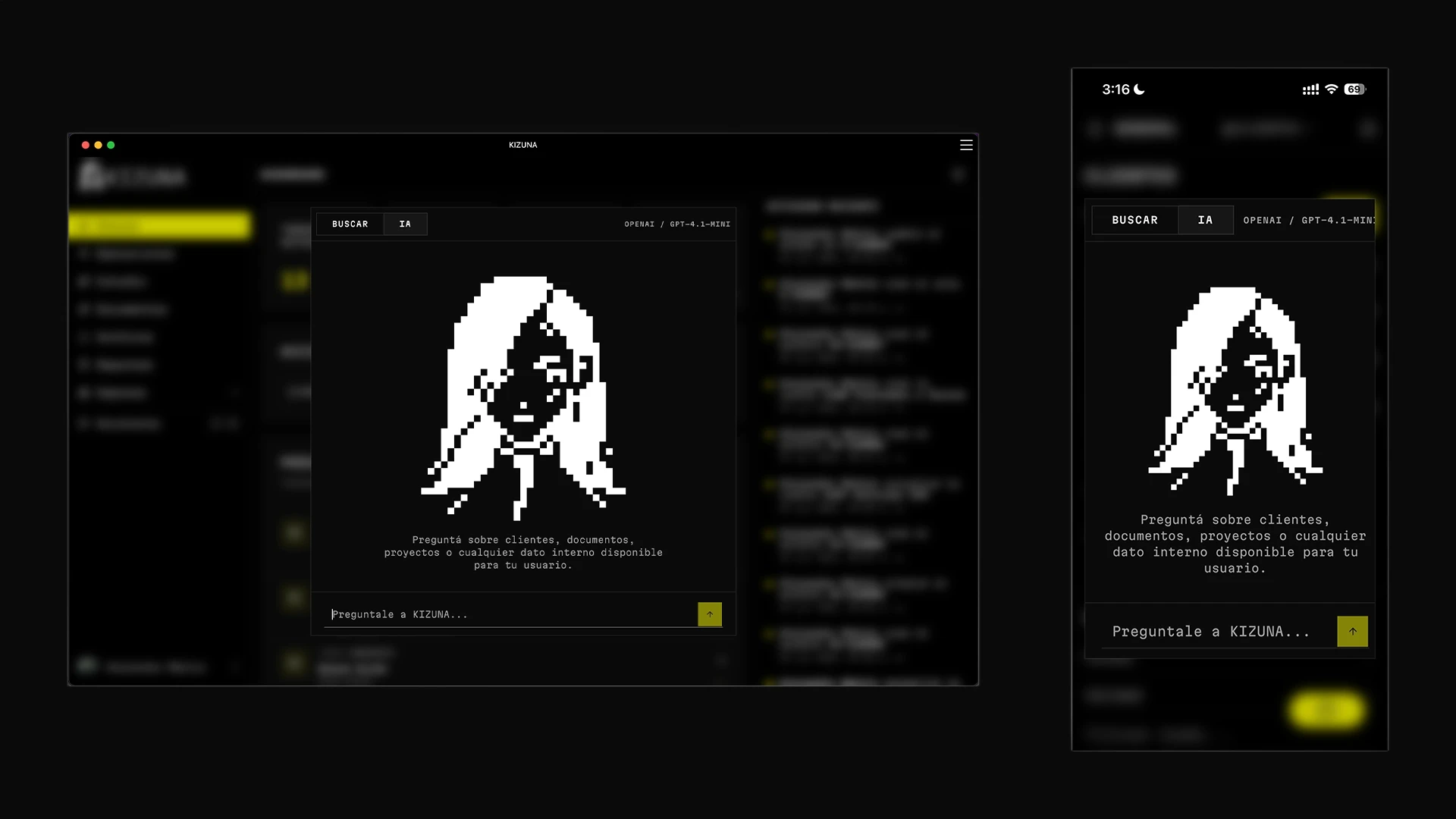
The Wompi integration allows payment links and scheduled charges to be generated directly from the platform. The system also includes a CalDAV-compatible agenda, integrated video calls powered by RealtimeKit, internal storage backed by Cloudflare R2, and an assistant primarily powered by GPT-4.1-mini through the OpenAI API, capable of accessing authorized information and making data and documents easier to retrieve through natural language. As a whole, KIZUNA™ Ops functions as a custom ERP with CRM capabilities built around AM25’s actual operations, rather than as a collection of isolated replicas of commercial tools.
Outcome
After one year of continuous development, KIZUNA™ Ops became AM25’s operational core and the primary source of context for the studio’s activity. Processes that originally depended on separate applications, external services, or manual management can now share information within the same system, reducing duplication and allowing data generated in one area to be reused by others.
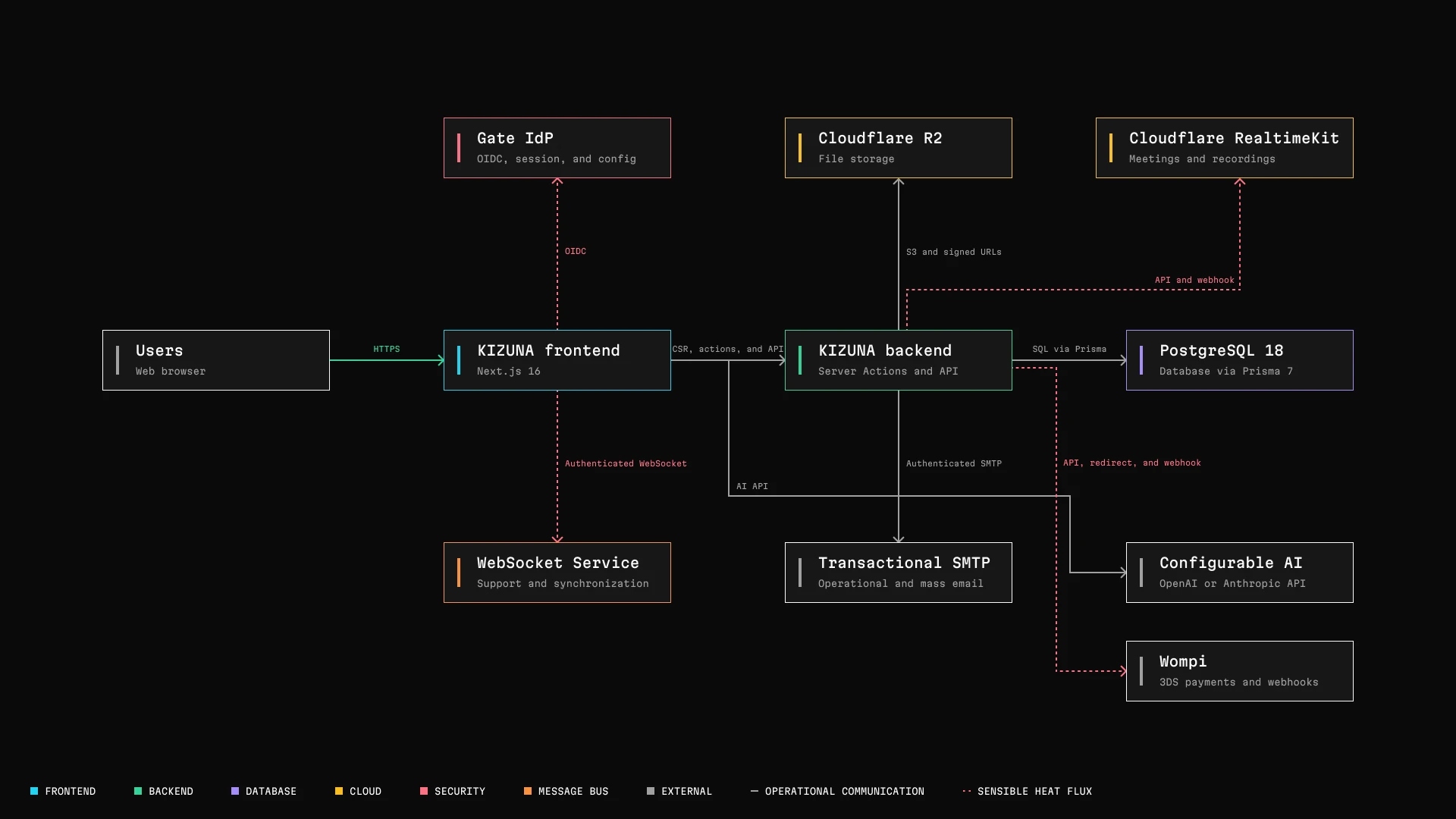
Rather than replacing third-party tools as a matter of principle, the platform makes it possible to decide which capabilities are worth controlling internally and which are better handled through specialized standards or APIs. The result is a private, centralized, and remotely accessible infrastructure that can continue evolving as the company’s needs change, without forcing its operations into the predefined structure of a commercial ERP.
Learnings
KIZUNA™ Ops showed that a custom business system does not need to begin with the intention of becoming an ERP. Its architecture emerged from solving small problems one at a time and later recognizing that they all shared related entities, data, and processes. Consolidating the original applications allowed that information to stop existing in silos and instead become a shared layer on top of which new modules could be built with significantly less friction.
The project also helped establish a clearer technical philosophy: building custom software does not mean eliminating every external dependency, but rather keeping control over what makes the workflow unique while relying on standards, services, and specialized infrastructure whenever they provide more value than rebuilding them from scratch.
Powered by Plank CMS
